Measuring air pressure #
Your car’s tire pressure #
The tire pressure is often listed in a visible place such as the driver’s door jamb. It is the pressure set by the car manufacturer, called the “recommended pressure” (指定空気圧). Check your car’s recommended pressure regularly.
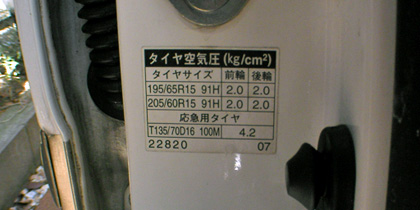
If you are using the same tire size as the original equipment, inflate to the pressure printed there.
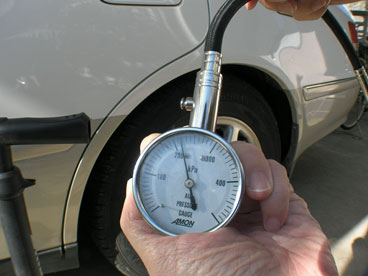
In this case the tire was over-inflated by about 10%. At that level it is within acceptable tolerance and safe to drive. If it bothers you, use a gauge with a pressure-release (deflate) function to bring it down to the recommended pressure.
If you are running larger or smaller wheels (inch up / inch down), adjust the pressure taking the tire’s load index into account.
Gauge used here — an Aimon gauge capable of measuring up to 500 kPa (see on Amazon)
Notes on measuring #
The recommended pressure is the cold tire pressure. After driving, tires heat up and the pressure reads higher — be aware of this.
When inflating, don’t lose the valve cap. Without a cap, the air you just added can escape. An aged valve can leak too — if pressure drops quickly, consider replacing the valve.
Low air pressure… #
Can cause a blowout #
Low pressure can lead to a blowout. It is said to be especially dangerous on the highway at high speed with too little pressure. Check that the pressure is correct before driving on the highway.
Pencil-type gauges #
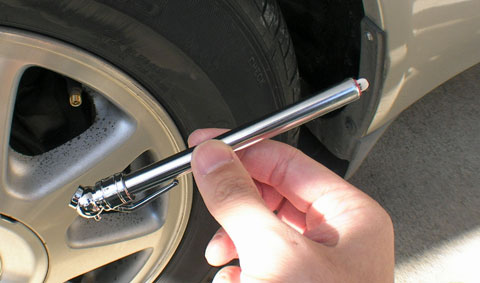
A pencil-type gauge is fine for measuring normal tire pressures. However, many of them top out around 300–350 kPa, so they may not be able to measure run-flat (temporizing) tires. In the photo above the recommended pressure is 420 kPa, which the pencil gauge in the photo below cannot measure.